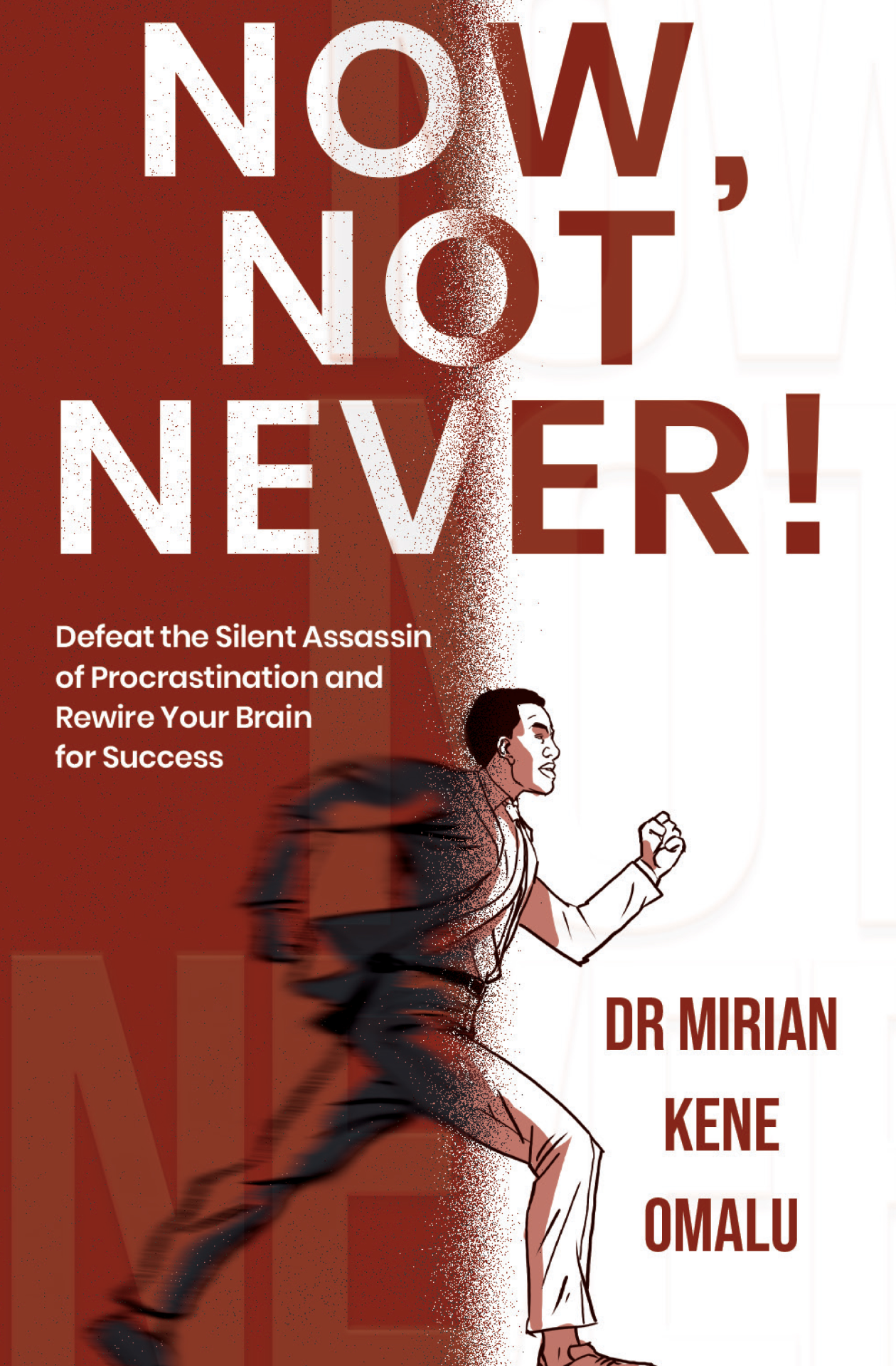
Now, Not Never

8,000.00
Osa

Are you tired of delaying your dreams?

Procrastination isn’t just a bad habit. It is a silent assassin that quietly sabotages your goals, confidence, and future. But what if the real problem isn’t your time management but your mind management?

In Now, Not Never!: Defeat the Silent Assassin of Procrastination and Rewire Your Brain for Success, transformational coach and neuroscience-based practitioner, Dr Mirian Kene Omalu, takes you deep into the brain’s inner wiring, exposing the subconscious blockers that keep you stuck in cycles of delay, doubt, and defeat.

Through her powerful, proven MindForm MethodTM, you will harness the science of neuroplasticity to reshape your thoughts, override fear, and silence excuses ‒ once and for all. You will learn how to reprogramme your subconscious mind through guided visualisation, emotional anchoring, and affirmation techniques rooted in cutting-edge brain research.

This is not just a book. It is a wake-up call. A blueprint. A transformation journey.

If you are ready to shift from hesitation to momentum, from fear to clarity, and from scattered effort to identity-based action, then the time is Now. Not never.

Walk boldly into your potential. Become the architect of your time, your habits, your success, and your future.

Now, Not Never
Published:
Author: Dr Mirian Kene Omalu

Chapter 1

Understanding Procrastination


‘I do my work at the same time each day the last minute.— Anonymous


Welcome to the procrastinators’ paradise, or as we like to call it, the perfectly normal state of wanting to put off until tomorrow what you can avoid doing today. If procrastination were an Olympic sport, many of us would not only participate but might even procrastinate on the podium! Jokes aside, let’s explore why we procrastinate, how it impacts us, and set the stage for overcoming this common challenge.

Procrastination isn’t just a quirky habit; it is a complex psychological phenomenon deeply rooted in our brains. This chapter dives into the neuroscience behind why we delay, debunks some common myths, and profiles the various types of procrastinators in a way that you will likely find a bit of yourself in each.


What Exactly Is Procrastination?

Procrastination isn’t just about being lazy or disorganised. It is a fascinating interplay of psychology, emotions, and neuroscience. It is the art of prioritising everything your brain

finds comforting over tasks that actually need your attention. Understanding this can shift our approach from self-blame to strategic management and mastery of our habits and choices.


The Neuroscience Behind Procrastination

Dive deeper into the brain’s mechanics, where the limbic system (our brain’s impulsive, pleasure-seeking part) often wins over the logical prefrontal cortex. Imagine these two parts of your brain in a constant tug-of-war, with the limbic system usually having the muscle power of a seasoned bodybuilder, especially when boredom or anxiety enters the arena.

Thus, at the core of procrastination lies a battle within the brain mainly between the limbic system, which seeks immediate rewards, and the prefrontal cortex, the planner that thinks about future consequences. When the immediate pleasure of procrastinating wins over the future benefits of action, you find yourself in the trap of delay. Understanding this can help you hack your brain’s wiring to favour the prefrontal cortex’s voice, making it easier to start and stick to tasks.


Common Myths about Procrastination

Myth: Procrastinators Have Poor Time Management Skills

Fact: Procrastinators often have excellent time management skills they just apply them unevenly. Many are capable of very efficient work, especially as deadlines approach. The issue is more about irregular application of these skills, often influenced by emotional states or task aversion, rather than an inability to manage time effectively. Thus, they actually have a ‘doing it at the last possible moment’ management problem.


Myth: Procrastinators Are Just Lazy

Fact: Labelling procrastinators as lazy is a common misunderstanding. Procrastination is not about laziness, which implies a lack of effort or motivation. Rather, procrastination is typically a response to anxiety, fear of failure, or overwhelming feelings associated with a task. Procrastinators often care deeply about the outcome but are paralysed by the pressure to perform or the fear of imperfection. They are often optimists who think 24 hours can magically extend if they need it to.


Myth: More Time Management Tools Will Stop Procrastination

Fact: While time management tools are helpful, they are not a cure-all for procrastination. Procrastination often has emotional roots (anxiety, fear, lack of motivation, etc.) that mere scheduling cannot address. Effective strategies often require addressing these underlying emotional and psychological barriers. Without addressing underlying emotional or cognitive reasons, new tools are just new ways to track how much you’re not doing.


Myth: Procrastination Is Harmless

Fact: It is a widespread belief that procrastination is a benign habit; merely an amusing character quirk with little to no real consequences. However, this view underestimates

the potential negative impacts of chronic procrastination. While occasional delays in tasks might not lead to significant harm, consistent procrastination can lead to a variety of problems including stress, guilt, loss of productivity, and deteriorating mental and physical health. Procrastinators often experience increased anxiety as deadlines approach, which can affect sleep patterns, mood, and overall well-being. Additionally, procrastination can harm personal and professional relationships, as it may lead to broken commitments and the inability to follow through on responsibilities. The cumulative effect of these issues can significantly reduce the quality of life and hinder personal and career growth.

Author: Dr Mirian Kene Omalu
Book Type

Hardcover, Paperback

Reviews

There are no reviews yet.

Be the first to review “Now, Not Never”

Your email address will not be published. Required fields are marked *